Clear View Project


Buddhist-Based Resources for Relief and Social Change


The Bodhisattva's Embrace

I am happy to announce that my book of essays - The Bodhisattva's Embrace: Dispatches from Engaged Buddhism's Front Lines - will be published in September.  I am grateful for advance praise from Joanna Macy, Jarvis Masters, Sulak Sivarksa, Roshi Joan Halifax, David Loy, Bernie Glassman, and others.

The Bodhisattva's Embrace assembles pieces I have written over the last twenty years from travels to troubled places in Asia and the U.S., along with dharma reflections on how to hold and alleviate the suffering we all see and experience. I have also included some of my photographs, intended to complement the writing.

The book will be available from Amazon in October — It takes them time to get the page up. —  from the Clear View Project website and from select local bookstores. You can push the button just below. 

And feel free, further down the page, to make a donation directly to Clear View Project.


The Bodhisattva's Embrace

$15.00


24 August 2010

Robert Aitken Roshi — A Personal & Biographical Reflection


Robert Baker Aitken — Dairyu Chotan/Great Dragon (of the) Clear Pool — died on August 5 in Honolulu at the age of 93. He was the “dean” of Western Zen teachers, a great light of dharma.  Aitken Roshi was a prophetic and inconvenient voice right to the end.  I have a picture of him from a year or two back, smiling impishly, holding up a hand-lettered sign that reads: “The System Stinks.”

Over the last twenty years I was privileged to collaborate with Aitken Roshi at Buddhist Peace Fellowship, to study with him at the Honolulu Diamond Sangha, and to help with editorial tasks on one of his books.  As thousands of readers found, his books are treasures — deep in dharma, crisp and vivid in voice, and ringing with the sound of justice.
Robert Aitken spent childhood years in Honolulu, not far from the Palolo Zendo he built later in life.  When I practiced with him at Palolo in 1996, he took me for a walk through his old neighborhood, pointing out the parks and houses, strolling along the beach at Waikiki and through the grand old parlors of the Royal Hawaiian Hotel.  He loved the air and sea.  The sounds of birds and geckos punctuated his lectures, calling him to attention.

During World War II, as a construction worker on Guam, young Robert Aitken was interned by invading Japanese troops and sent to a camp in Kobe, Japan for the rest of the war.  A sympathetic guard gave him a copy of R.H. Blyth's Zen in English Literature and Oriental Classics which he read over and over. In 1944, by chance, Aitken and Blyth, who also been interned in Japan, were transferred to the same camp.  They became close friends, and Aitken determined he would study Zen with a true master on his release.

He returned to Hawaii and earned a bachelor’s degree in literature and a master’s degree in Japanese language. A thesis on the great Zen poet Bassho became his first book, A Zen Wave. In the late 1940s he began Zen studies in Los Angeles with the pioneering teacher Nyogen Senzaki. He went to Japan in the early 50s to practice with Nakagawa Soen Roshi, one of the 20th century’s most original Rinzai monks, who invited him to lead a sitting group in 1959, placing Robert Aitken among the very first western Buddhist teachers.  

From 1962 on, Aitken organized sesshins for Yasutani Roshi, whose Sanbo Kyodan (Three Treasures) school merged the shikantaza emphasis of Soto with rigorous koan work of the Rinzai school.  Studying with Yasutani, and with his successor Yamada Koun Roshi, Robert Aitken was authorized to teach independently, and became known as Aitken Roshi.  The Diamond Sangha arose from his travels and teachings. It now has more than twenty affiliates around the world, and a cadre of accomplished and transmitted dharma heirs.
 
Aitken Roshi, his wife Anne, and Nelson Foster founded the Buddhist Peace Fellowship on the back porch of the Maui Zendo in 1978.  The idea was to further the interdependent practice of awakening and social justice.  The spark for BPF was struck from Roshi’s in depth study of 19th and 20th century anarchism, and his long experience as an anti-war and anti-military activist.  BPF continues to this day with the same mission. In a later book, Encouraging Words, Aitken Roshi wrote that "monastery walls have broken down and the old teaching and practice of wisdom, love and responsibility are freed for the widest applications in the domain of social affairs."  
   
I was drawn to Aitken Roshi’s books in the 1980s, first reading his classic Taking the Path of Zen (1982), a primer on Zen practice.  I have a copy of The Mind of Clover (1984) signed at a reading at Black Oak Books in early 1985.  In my reckoning this is still the best book around on practical Buddhist ethics.  But among his thirteen published books (with more to come, I hope), I would also point out The Gateless Barrier — Roshi’s translation of the Mumonkan koan collection — and The Practice of Perfection, his commentary on the paramitas or Mahayana “perfections.”
   
Aitken Roshi was a disciplined writer. That was an essential part of his daily practice, writing for several hours each morning, trying to avoid interruptions and distractions.  Several times I found him reading aloud to himself, polishing the language and voice until it sounded right to his ears.  You can hear that distinct voice in every page he wrote.
   
There is an image near the end of the Avatamsaka Sutra, the pinnacle of early Chinese Hua-Yen Buddhism, that Aitken Roshi often cited. Similar to the interdependent reality of Indra’s Net, he delighted in the idea of Maitreya's tower, extending into and throughout space, encompassing an infinite number of towers, one as brilliant and astonishing as the next. And somehow these towers co-exist in space without conflict or contradiction. I think this dazzling vision is how Roshi saw the world.  It is also how we can see his mind and work.

Aitken Roshi never found an inch of separation between his vision of justice and the Zen teachings of complete interdependence.  The vast universe, with all its joys and sorrows was his true dwelling place.  It still is.  Robert Aitken Roshi, presente!

— Hozan Alan Senauke
August 2010


We invite you to make a donation to Clear View Project, supporting our work in Burma, India, and in the U.S.
Click on the Paypal link below

 
Clear View Project


Sitting at Montague

 Musings on Montague:
The Western Socially Engaged Buddhism Symposium — August 2010


This is a personal reflection on the Symposium.  The questions are my own.  If they resonate with you, lets talk.  For those of you on Facebook, an album of photographs I took at Montague is available on my FB page.  Click on Photos, scroll down and you will see the album “Socially Engaged Buddhist Symposium.”


The hills of western Massachusetts were deep green and the air was steamy as I arrived at the Zen Peacemaker’s Mother House in Montague. Soon we were off and running, a six-day engaged Buddhist marathon with 150 to 200 participants, and nearly 60 presenters.  This was the vision of Bernie Glassman, founder of the Zen Peacemakers, implemented by his staff — to gather activist practitioners, organizations, leaders, and academics to:

• to promote the practice of Socially Engaged Buddhism,   
• to inspire and encourage members of the Western Buddhist community to join this worldwide movement,?      
• to bring together the leading practitioners and theorists in this movement,?      
• to explore the breadth of activity being undertaken by socially engaged Buddhists,?      
• to open opportunities for people to get involved by volunteering, joining training
     programs, and finding internships and jobs in Socially Engaged Buddhism.

Among the presenters were Buddhist teachers — Bhikkhu Bodhi, Bernie Glassman, Roshi Joan Halifax, Paul Haller, Taigen Leighton, Paco Lugovina, Enkyo O’Hara, and Matthieu Ricard; artists and writers Jeff Bridges, Krishna Das, Akim Funk Buddha, Peter Matthiessen, Mayumi Oda, and Anne Waldman; academics and scientists — Daniel Goleman, Jon Kabat-Zinn, Ken Kraft, Stephanie Kaza, Sallie King, David Loy, Chris Queen, Peter Senge, Robert Thurman, and Jan Willis; and dharma activists Mirabai Bush, Paula Green, Sister Clare Carter, Fleet Maull, Frank Ostaseski, Sarah Weintraub, and Burmese monks from the Saffron Revolution.  There were more! And of course, there were other friends, activists, and teachers I wished were present.  But the wealth of experience and wisdom was extraordinary.  

The days broke out into six broad areas, with meditation, keynote speakers, panels, discussion groups, and entertainment in the evening (which — I confess —I missed, retreating to the quiet of Paula Green and Jim Perkin’s woodland home after a day of incessant talk and social energy).  Topics for the days were: 1. Roots & Challenges, 2. Community, 3. Social Entrepreneurship, 4. Justice & Activism, 5. Wellness & Healing, and 6. Arts & the Future.

For detailed information on presenters, themes, panels, and so forth, see the Zen Peacemaker site < http://www.zenpeacemakers.org/soc_eng_bud/symposium.htm>, where the staff is posting text, synopsis, and making DVDs available for purchase.   My own memory and notes will hardly do justice to the great richness and challenge of the week.

It was a wonderful gathering, long overdue.  The connections made will fuel work long into the future. I am very glad to have been there all week, taking it all in.  I am grateful and a little embarrassed, as well, to have been honored on stage — along with Paula Green, Joan Halifax, Peter Matthiessen, Frank Ostaseski, and Jon Cabot-Zinn — as a kind of “pioneer” of engaged Buddhism.  Really, I looked out on a room full of friends and teachers who continue to inspire me. Many of them belonged on the stage.

Anyhow, those present at Montague, and all those who will feel the ripple effect, owe a great debt of thanks to Bernie Glassman, program director Chris Queen, and the whole Peacemaker staff, who worked ceaselessly to help us feel creative and at home.

Having laid out some of the detail and appreciation, there are broader issues I would like to address: agreements, disagreements, and open questions.  These considerations are my own, and I will avoid naming names or delineating various presenters’ positions. Over the course of the week it was easy to see a number of contrasts or kinds of activities that all can be considered “Engaged Buddhism” or “Socially Engaged Buddhism.” I don’t see a particularly useful distinction between these two rubrics.  Engaged Buddhism, Socially Engaged Buddhism — both include a systemic view of suffering and liberation.  Elsewhere I have written:

What is socially engaged Buddhism? It is dharma practice that flows from an understanding of the complete and endlessly complicated interdependence of all life. It is the practice of the bodhisattva vow to save all beings. It is to know that our liberation and the liberation of others are inseparable. It is to transform ourselves as we transform all our relationships and our larger society.

Or, as Gary Snyder wrote, nearly fifty years ago in the Journal for the Protection of All Beings #1: 

The mercy of the West has been social revolution; the mercy of the East has been individual insight into the basic self/void. We need both.

These definitions, of course, demark a wide field of action. (The notion of a Western Socially Engaged Buddhism is something I will address later.)  On one end of the field is social service.  This might include hospice, tending the ill, feeding the hungry, bringing material and spiritual support to institutions and places in which people are suffering.  These places are essentially dukkha warehouses, with their own gravity or magnetism, drawing in and generating further suffering. In his early teachings the Buddha set down Four Requisites for establishing a practice of liberation: food, shelter, clothing, and medicine.  Providing these requisites in the spirit of compassionate, selfless action, without the smell of charity and without proselytizing, is Buddhist social service.

On the other end is social activism, social change, and even, as Snyder proposed, social revolution. This is the prophetic dimension of engaged Buddhism.  Since Buddhism really has no prophetic tradition, this vision of social transformation is truly a merging of West and East. Yet it has been transmitted from Asian teachers like Thich Nhat Hanh and Sister Chan Khong, Dr. B.R. Ambedkar.  A.T. Ariyaratne, Sulak Sivaraksa, His Holiness the Dalai Lama, and many others, known and unknown.  Now it is part of our practice: resisting war and militarization, advocating against the death penalty and the delusion of retributive justice, holding the multinational corporations accountable for their destruction of life and the environment. Looking at the Four Requisites, Buddhist activists understand, for example, that the for-profit medical system in America creates illness and death without dignity for vast numbers of people.  We understand that affordable housing has ceased to be seen as a goal and a common good by the powerful banks and lending bodies.  As Robert Aitken Roshi was always ready to say: the system stinks!

But these ends are not in contradiction.  They are part of the common field of human action, which includes enlightenment and delusion. Simply feeding a man in need, comforting a woman in her last hours is necessary dharmic action.  At the same time, if we can stop or slow down the wheels of war, lives are saved.  That is also dharmic action.  And social service can be combined with social change. One can simultaneously do hospice work and fight for universal medical care. When teaching in prisons I carefully (and quietly) present my understanding that the American prison system itself is essentially most part unjust, racist, and self-perpetuating.

The teachings of right view tell us to see what is directly in front of us.  At times that vision is very close and intimate.  In other moments it reaches the most distant horizons.  Wherever we look we are seeing into the nature of interdependence itself, seeing that things change.

On the Symposium’s first day I was on a panel considering challenges for Engaged Buddhists.  I began by speaking about Aitken Roshi, who had died several days earlier in Hawaii.  He was an unstoppable voice calling out for justice, despite the fact that Buddhism speaks much more about what is just — balanced and harmonious — than about justice. Engaged Buddhism may not have taken shape without him.  Certainly there would be no Buddhist Peace Fellowship.  As for me, I would not be writing these words without Aitken Roshi.  I went on to say:

The challenge that faces socially engaged Buddhists in the West is to sustain a radical and internationalist vision.  That means finding common action and common practice with the most oppressed and those most hungry for dharma here in the U.S. and around the world.  It means, further, understanding just how our privileged lives in the this country depends on and is interwoven with the labors and resources of peoples far away and out of our immediate sight.  

Through the week another set of contrasts became clear.  In one sense, it reflects an ancient tension.  Is Buddhism a religion, or is it a kind of philosophy Another aspect of this question is whether engaged Buddhism is about liberation itself — individual and social freedom from attachment to self — or is it a toolbox for relief and amelioration?  I confess that simply framing that last sentence suggests my leanings.  Cases for both sides were made by presenters, without explicitly arguing against one side of the other.  

I am an “old age” (as opposed to “new age”) kind of guy, so I favor close attention to Buddhist tradition.  Not just my own Zen tradition, both those of the other Buddhist schools with Asian roots.  In this regard, my Buddhist training resembles my training as a student and performer of American traditional music.  One studies with true teachers/plays with the old-timers whenever and wherever one can.  One reads the books/listens to the source recordings. One looks at and visits the cultures where a practice or a musical tradition flourishes.  In the end, or in the process, one must learn to be authentically oneself, with ones own voice and understanding.  In the realm of Zen, I will never be Japanese or Chinese.  In the realm of blues, bluegrass, old-time music, I will never be from the rural South.  To be true to my teachers and sources means to be completely myself, which allows for freedom and creativity. It also includes honoring a tradition and encouraging its transmission.

This does not answer the question of whether Buddhism is religion or philosophy.  It may, in fact, be a false question, if one considers the idea of “religion” an artifact of Christianity and western scholarship.  In Asia the term Buddha sasana is often used, meaning something like the Buddha way or life, being or becoming Buddhas. Shakyamuni Buddha, live like him!

Buddhists in every age and culture have served their communities as educators and healers, as counselors and spiritual guides. In robes or in civilian clothes I trust they will continue to do such things. My concern, though, is if we see engaged Buddhism as a toolbox, over time we will lose site of the depth of the tradition, hence of its highest principle, anuttara samyak sambodhi, unsurpassed complete enlightenment. Actually I surprise myself by writing these words.  As I am still mired in delusion, I have no certainty of attaining such liberation (in this lifetime, at least).  But, in faith, it is the mountain that is always before me and within me. So I press on.

Engaged Buddhists of an instrumentalist bent are doing amazing work, bringing mindfulness into the mainstream of American social thought.  These pioneers are themselves fully grounded in Buddhist practice and thought.  But as the mainstreaming of Buddhist practices moves from hospices, hospitals, and prisons, to corporations and even the military, I feel uneasy.  Can corporations be more “dharmic?”   For that matter, can an oil company or chemical manufacturer be “green?”  One cannot withhold compassion or ignore the stress and suffering of a soldier in Iraq or Afghanistan.  But does mindfulness within the military or multinational corporations (or, for that matter, within prison walls) lead to liberation?  Or is it a tool that encourages acceptance of where one is working or serving beyond the influence of sila or morality?  That path suggests something like a Brahmanic notion of karma as duty, cleaving to ones place in society, however oppressive it might be. Mindfulness is often proposed as inherently beneficial. Mostly that is true.  But, when cut off from morality, it can also serve to pacify or placate appropriate anxiety about our actions in the world.

Mindful consumerism is still consumerism.  Mindfulness on the battlefield will not stop the killing.  If Buddhism is radical — to the root — its radicalism is based on the Three Treasures: sila, samadhi, prajna/morality, concentration or mindfulness, and wisdom.  These three are necessary and inseparably the essence of Buddhism. We have to strike off the chains of resignation and passivity.

Again, I need to say that I am not opposed to so-called mainstreaming.  It is part of the inevitable process of creating a Western Buddhism, just as Buddhism has historically merged with local cultures wherever it settled  But Gandhi quipped when asked about Western civilization — “I think it would be a good idea.” I feel similarly about Western “culture.”  Do we actually have a culture, or are we driven, like hungry ghosts, by insatiable appetites and an economic engine that turns even the best efforts and intentions into something commodified, to be consumed?  Sorry if this seems pessimistic.  But we have to ask hard questions.

This leads back to something I touched on earlier.  This event was billed as “the first symposium for western engaged Buddhism.”  There are a number of issues embedded in this title.  First of all, the question of “first.”  Second, is there a “western engaged Buddhism.”  I guess the former hinges on ones position on the latter. Nearly twenty years ago, in the summer of 1991, Buddhist Peace Fellowship organized the first of several summer institutes, with more than 150 participants, and teachers including Robert Aitken, Joanna Macy, Dr. A.T. Ariyaratne, Christopher Titmuss, Deena Metzger and others.  Like the gathering at Montague it was an incredibly rich week, which yielded friendships I still treasure.  It also led, directly and indirectly, to the creation of BPF’s BASE and Prison programs, the forming of a Gay Buddhist Fellowship, and other connections that still flourish years later.  

It is not useful, perhaps, to compare Buddhist Peace Fellowship with the Zen Peacemakers, or with this symposium.  Our branches, from the single common root of Bodhisattva Vow, are diverge.  But I will argue that engaged Buddhism in the West is intimately linked to engaged Buddhism in the East.  With great difficulty, our founding teachers came from all across Asia to the West to bring us their dharma. The impact of western (U.S. and European) capitalism and military force is felt everywhere. The price of agricultural goods in rural India or Thailand is tethered to a worldwide market.  The weather in Burma, Tibet, and Africa is bound up with the production of hydrocarbons in the U.S., Europe, and other developed nations.  And finally, I know that engaged Buddhists in Asia extend their hands in partnership with those of us in the West.  They recognize that, as Aitken Roshi liked to remind us, “We’re all in this together.”

All of the above is not criticism.  These are simply questions I have, which were sharpened by the opportunity to be with challenging friends — participants and presenters — for a week in the hills of Montague.  Agreeing and disagreeing, enjoying the give and take of ideas is itself a great pleasure.

Oh, I had fun, too.  We had a great bed & breakfast scene at Paula Green and Jim Perkins’ house, with Ken Kraft, Stephanie Kaza, Davis Teselle, and myself in attendance.  I got to play some informal music with Jeff Bridges, who might have a career as a singer if the acting thing doesn’t work out.  Mostly, I just had a chance to talk with friends.  Someone observing me there asked, “Don’t you ever get tired of talking to people.”  No, not if the words are flowing, ideas are sparking, and hearts are meeting.


March 2010

Buddhism Among India’s Most Oppressed: Notes & Impressions

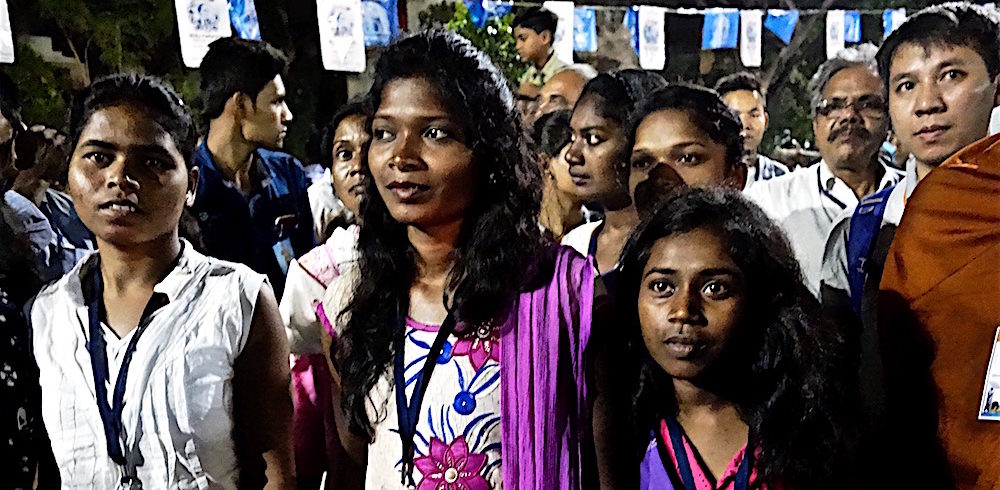
I am just back from several weeks in India, learning and teaching in the “untouchable” communities of Maharastra. This is a movement I have wanted to visit and feel since I first learned of it, more that twenty years ago. The experience was wonderful and very powerful — the sweetness, sincerity, intelligence, and generosity of all those I met lingers still.  Jetlag aside, a piece of my heart remains with these friends from Trailokya Bauddha Mahasangha Sahayaka Gana (TBMSG) in Pune, Nagpur, and Mumbai...


To read my first full report, please click on the link here: India Report

In the next few months I hope to do more writing about Buddhism in India, and to develop a program of support for Dalit students at the unique Nagarjuna Training Institute/Nagaloka. After a benefit at Berkeley Zen Center, we raised enough money to support two students at Nagaloka for the coming academic year.


Dr. Ambedkar, Mumbai
______________________________
Join Our Email List

Email:  
For Email Marketing you can trust


__________________________________________________________________

Dalit students at Nagaloka

______________________________________
Our good friends from Burma Partnership, on the Thai-Burma border, have been providing the most accurate information and news about Burma and its democracy movement for years now.  We are glad to see that at last they have a new web presence which will offer regularly updates on activities and political/social developments inside and outside of Burma.  We encourage you to check their website regularly: www.burmapartnership.org.
_______________________________________________

 
Stupas at Bhale Caves


Adopt a Monk


Clear View Project
urges you to support our program to Adopt a Monk from the Saffron Revolution. We need your help to keep hope alive for monks and nuns in Burma's nightmarish prisons. For full information on Adopt a Monk, click on the link on the right side of this page. To make a donation, click on the button below to make a donation now. Thanks.

— Alan Senauke

Adopt a Monk/CVP


____________________________________

Recent Attacks on Tribal Buddhists (Jummas) in Bangladesh’s Chittagong Hill Tracts (CHT)


The message below was forwarded by an old friend Ven. Bimal Bhikkhu, a Chakma monk now living in Calcutta. It comes from “Bulletin on CHT Published by Bangladesh Hindu Buddhist Christian Unity Council (BHBCUC)”— 16th Mar  2010.  

I have made several visits to the Hill Tracts (CHT), where I was moved by the sweetness of people and deeply troubled by the government and Bengali settlers’ theft of tribal land and attacks on their lives and ancient culture.


The BHBCUC website is: www.bhbcuc-usa.org
Further information on Indigenous Buddhists in Bangladesh can be found on these two sites:
http://www.survivalinternational.org/tribes/jummas
http://jummapeoplenet.blogspot.com/


Between 19th and 20th February, the Bangladesh military in collaboration with a fresh wave of Bengali settlers carried out arson, looting and killing of the JIP in Baghaichari , Chittagong Hill Tracts (CHT) region of Bangladesh.  As a result of this attack, at least six Jummas have been killed, 25 seriously wounded and 200 houses, including the UNDP (United National Development Program) office were burnt to the ground. The attackers looted and destroyed Buddhist temples and Christian churches. The authorities imposed section1442 in the area which meant that the JIP could not come out to collect their dead and wounded.  
 
On the morning of February 23, in response to these attacks, the UPDF (United Peoples’ Democratic Front – an indigenous people’s organization) organized a protest demonstration on the streets in the Khagrachari Area of the CHT.  Bengali settlers came out in hundreds with knives, sticks and machetes. To avoid further confrontation with the settlers, the UPDF immediately stopped their procession and dispersed. But the settlers continued to gather in large numbers. About 200 of them then set fire to indigenous villages throughout the Khagrachari area. The police and the military did not intervene in any way; they did not stop the settlers nor did they take any action later.
 
A BRIEF HISTORY OF THE CONFLICT
The above two incidents are part of an on-going interethnic conflict between the indigenous peoples on one side and ethnic Bengali settlers supported by the military on the other, which began when the Bangladesh Government relocated about 500,000 settlers from the plains of  Bangladesh to the CHT.

The CHT area in Bangladesh is the home of a dozen indigenous groups who are distinct and different from the majority Bengali population of Bangladesh with respect to language, religion (Buddhist, Hindu and Christian), culture and ethnicity.
 
TIMELINE
1860 British colonial rule – limited self-government and ban on migration to the area protects indigenous population.
1947 independence from British rule; creation of Pakistan -- loss of special status and autonomy. Large influx of non indigenous settlers.
1957-1963 building of Kaptai dam and Karnaphuli hydroelectric project – 400 square miles of land submerged and 54,000 acres cultivable land lost. 100,000 indigenous people lost homes and prime agricultural lands.
1971 – Bangladesh emerges after civil war with Pakistan -- PCJSS (Parbattya Chattgram Jana Samhati Samitti), the political organization of Jumma people leads autonomy movement.
1972 -- Demands for autonomy rejected by Bangladesh government. Shanti Bahini, armed
wing of PCJSS formed. Bangladesh government deploys approximately 120,000 armed forces in
the area and brings in about half a million ethnic Bengali settlers.
1972 – 1997 -- counter-insurgency operations result in massacres, forced relocation, displacement, raping of women, burning of villages, looting and plundering of homes, arbitrary arrests, and forced land-takeover. Refugees flee, many across the border into India 
1997 -- 2nd December  In hopes of bringing peace, PCJSS negotiate agreement with Bangladesh government. Shanti Bahini surrenders their arms.  Peace accord signed with PCJSS and Government of Bangladesh. Since then, successive governments of Bangladesh have never implemented any the terms of peace accord -- return of lands forcibly taken away from the indigenous people; withdrawal of the army; withdrawal of the settlers from the CHT.   
2009 – return to democratic rule in Bangladesh – government of Sheikh Hasina moves to implement 1997 CHT peace accord.

Current situation: Despite the return to democratic rule in Bangladesh in 2009 and the subsequent move to implement the 1997 peace accord by removing some troops from the area, the current violence has ended these positive developments.  Though the government has been assuring protection, settlers supported by the military are moving about with lethal weapons threatening the Jumma people. The settlers act in the presence of police and army. The police claim helplessness in the face of unruly mobs. The destruction goes on unabated.  The Jummas who are already attacked and those who live in fear of being attacked, feel left to the mercy of the settlers. They are driven from their homes. Many take refuge in the forest.  Young Jummas are being arrested by the police and the army. The settlers are still freely going to Jumma houses, taking valuables and then setting them on fire.

Demands
1. that an international team investigate the two incidents and that the perpetrators are brought to justice;
2. that the government of Bangladesh with immediate effect ensures a stop to any further arson, looting and killing by the military and the settlers;
3. that Bengali settlers are relocated outside the CHT;
4. the withdrawal of military camps from the CHT;
5. the implementation of the Peace Agreement without further delay;
6. that a portion of on-going Canadian development aid to Bangladesh should go to the victims of this communal conflict in the CHT.
 
 
A BRIEF REPORT FROM THE 2009 INEB CONFERENCE

The International Network of Engaged Buddhists (INEB) was created in 1989 by Thai social activist and writer Sulak Sivaraksa and a small circle of like-minded friends — kalyanamitta  — in Asia and the West. I have been attending INEB conferences — first annually then bi-annually — for the last eighteen years, and this expanding circle of spiritual friends has been an essential source of support and education for me, and a venue for Buddhist action in Asia.

Our resources have always been limited — one more or less fulltime staff person and a small office — so INEB has, of necessity, functioned as a network. The conferences, beyond the presentations and plenaries, allow people to meet and develop ideas for local, national, regional, and topical programs that operate independent of INEB’s direct coordination. In the past this has led to training for women’s empowerment, support for environmental action by Thai monks, collaboration with ex-untouchable Buddhists in India, witness delegations to Burma, Bangladesh, and Cambodia, and many more grassroots activities.  INEB's Think Sangha (about which more later) evolved in the 1990s from a group looking at the need for Buddhist social analysis. While networks and projects may be ephemeral, the relationships among us endure.

This year’s conference, INEB’s 20th anniversary, was organized in and around Chiang Mai in the north of Thailand. Over the course of a week’s activities — including a three-day meditation retreat led by Dharmachari Lokamitra from Friends of the Western Buddhist Order and Trailokya Bauddha Mahasangha Sahayaka Gana (TBMSG) , the conference itself, talks and cultural evenings at Wat Suan Dok, an international alms round collecting money and medicine for Burmese refugees, a day-long festival of engaged Buddhism, and an evening peace walk through the crowded streets of Chiang Mai — more than two hundred people, lay and monastic, took part.  By my count there were representatives from Thailand, Burma, Vietnam, Cambodia, Laos, Indonesia, Malaysia, Japan, Korea, Taiwan, Sri Lanka, Bangladesh, India, Bhutan, Nepal, Ladakh, Tibet, Europe, South Africa, Australia, and the U.S.

Aside from the heat — it was in the nineties for my first four or five days in Thailand — in the midst of great busyness some vivid points come to mind.

• The strong presence of youth and the promise of generational continuity. There were articulate and dedicated young people in almost every Asian delegation.  Tempel Smith, with whom I worked at BPF, brought a group of eight youth from the U.S., at the start of a six-month Asian immersion Tempel has organized.

• Large and active participation from a number of countries — Burma, Sri Lanka, India, Japan, and more — which allowed for the creation of national and regional working groups following up from the conference.

• The leadership and visibility of women in virtually every aspect of planning and presentation.  Looking back over my years in INEB, though patriarchy has not completely disappeared, this seems to me something we are getting right.

• The return of many old friends for this 20th anniversary, some of whom had been apart from the network for ten years or more.

I am grateful to the conference organizers for several opportunities I was given to present and share ideas.  At the conference plenary, Ven. Dhammananda, the formidable Thai bhikkhuni, and I spoke about our experience and vision of engaged Buddhist community and organization. I helped my old friend Ouyporn Khuankaew explore issues of gender. On the last day I took part in an interfaith panel —Buddhist, Christian, Muslim — looking at spiritual practices that support our respective social action.

In the Upaddha Sutta the Buddha explains to Ananda that kalyanamittata, spiritual friendship, is the all of the holy life. This understanding is at the heart of INEB. Over all these years friendship is the mysterious force that draws me across the ocean again and again.  Maybe it is not, at last, so mysterious. “Only connect” — this is the watchword of sentient beings.  We yearn for connection on the deepest biological level, and then, laboring in delusion, we build walls of self, race, gender, nation, and so on to protect ourselves from the responsibilities that come with connection. If we remember “only connect” and cultivate connection as we strive to do at INEB, then the suffering and joy of our many lives becomes our common human treasure.

I include below the statement read at Chiang Mai’s ancient Tha Pae gate, at the end of our peace walk.


INEB CONFERENCE STATEMENT

This week in Chiang Mai the International Network of Engaged Buddhists celebrated its 20th anniversary with a successful conference dedicated to peace and social transformation. As kalyanamitta, more than two hundred socially engaged Buddhists from twenty-five countries – from Asia and the Pacific region, from North America and Europe – joined together for study, dialogue, and dharma practice, committing ourselves to work for peace.

We affirm our deep belief that the suffering of society – war, racism, poverty, gender oppression, destruction of the environment, and cultural degradation – can be transformed into liberation for all beings.

We affirm and have seen ourselves that peace can arise from even the fiercest of conflicts.

Together we confronted critical concerns that affect life on this precious and fragile planet:
                                                
     • the intertwined disasters of consumerism and environmental destruction;
     • the vital need to empower and educate young people;
     • the pervasive oppression of women, and all gay-lesbian-bisexual-transgendered men & women;   
     • the denial of human rights and meaningful livelihood;
     • the need to preserve Buddhism and all traditional culture and religion;
     • and the obscenity of war, civil strife, and violence.

These concerns, wherever they arise in the world are our concerns.  They are close to our hearts. In the Buddha's way and in the way of every great religion, we know that we must meet this suffering not with faith alone, but with all our efforts and action day by day.

— 17 November 2009      


Burmese Monks demonstrate outside the G20 meetings in Pittsburgh. 

See the YouTube link below.


http://www.youtube.com/watch?v=h--aMgZMzSo
Margaret Howe writes about the Burmese presence 
at the G20 meetings in Pittsburgh, September 22-25

The monks in maroon robes maintained a strong meditative presence as they waked single file through city blocks filled with armed police in full riot gear and semi-automatic rifles, protecting the heavily barricaded convention center. While these monks, who had fled a brutal dictatorship to come to the home of democracy, were allowed this peaceful demonstration in Pittsburgh,  the riot police and barricades protecting the economic elite were eerily familiar.

20 Burmese monks from around the country and Canada met in Pittsburgh last month, to “take their case” to the world leaders assembled there for the G-20 Economic Summit. On the 2nd anniversary of the Saffron Revolution, the monks decided that this was the auspicious day to pay tribute to the killed and imprisoned monastics and their struggle for democracy in their country.

Clear View Project helped organize the activities for the Burmese during three days in Pittsburgh, where there were panels, peace walks, and joined by scores of Burmese supporters.

Most of the gathering was peaceful, if boisterous.   On Thursday, the first day of the Summit, the monks walked down the middle of downtown Pittsburgh with scores of American and lay Burmese supporters. Popping out of stores and restaurants, on-lookers, as well as the ubiquitous police felt their presence and snapped photos. Finally, arriving as close as they could get to the Convention Center where the Summit was taking place, they sat in the street in silent meditation and chanted the Metta Sutta.

Special thanks to
Henry and Diane at Pittsburgh's City of Asylum, Khet Mar and her family, and the Our friends at the Mattress Factory.  They did so much to make it the success it was, from setting up the incredible film screening at the Mattress Factory, providing a videographer for the events, finding us umbrellas, food, lodging, and going with the ever-changing flow of Burmese monks and political life. 


WHY WE COME TO PITTSBURGH FOR THE G-20 ECONOMIC SUMMIT

We are Burmese monks and democracy activists and we have lived under a brutal regime for the last 45 years. Most of us are in the United States because we fled our country’s brutal policies over the last 20 years.

We come to Pittsburgh to take our case to the world leaders as they meet together. These   countries gathered here can help affect change in our country. We need the assistance of the International Community to make change in Burma. The Generals in power are intransigent in their ways. They must be influenced by the international community to allow the Burmese people to live without fear and in freedom.

We appeal to the 20 countries who are gathered here, Argentina, Australia, Brazil, Canada, China, France, Germany, India, Indonesia, Italy, Japan, Mexico, Russia, Saudi Arabia, South Africa, South Korea, Turkey, United Kingdom, United States, European Union to take direct action on Burma.

We ask you to listen to Archbishop Desmond Tutu’s call for a UN Security Council Commission of Inquiry and a global arms embargo on Burma.  The Burmese junta must be made accountable for their genocide of the ethnic people, tens of thousands of child soldiers, wide-spread use of modern-day slave labor, and widespread rape of ethnic minority women.

A new Human Rights Watch Report names 2100 political prisoners in Burmese jail including 220 monks and nuns. Monks and nuns are forcibly dis-robed and not permitted to carry out their monastic duties.  Many of these have been given outrageously long prison sentences.

Conditions in Burmese jails are dreadful. For political prisoners, ill treatment and torture are commonplace. Punishments include being put into stress positions, beatings, and isolation in cramped and dark cells, otherwise known as “dog cells.” Food and medical treatment are often poor or non-existent, and in many cases prisoners have to pay for it  themselves. “ (HRW Burma’s Forgotten Prisoners, 9.09)

The United States is now reviewing its stance towards Burma. We beseech the US and all nations to be more firm with Burma and not to ease up on the sanctions in place. The Burmese are almost unanimous in our analysis of the merit of further sanctions.

The United States and many other nations have imposed sanctions on Burma. That is their decision and in keeping with their justified solidarity with the democratic values that we all hold so dear. If the regime genuinely engages with the NLD and ethnic representatives, releases political prisoners, ceases attacks against ethnic minorities and takes additional steps to build a true democratic state, these sanctions will be repealed at the right time.                 U Win Tin  NLD party member

"The US government should engage, but the most important thing is keep the sanctions in place" unless the junta takes steps like freeing political prisoners.”
        Venerable U Pyinya Zawta,  lead monk in the 2007 Saffron Revolution,
spent ten years in prison and now lives in US
"The United States, China, India and Burma's neighbors in Southeast Asia should make the release of all political prisoners a central goal of their engagement with Burma, and use every tool of influence and leverage they have to achieve it.”
                Tom Malinoski Human Rights Watch
 
The international community must  be united in their stance towards Burma. China and India, Burma’s neighbors, must support effective means of pressuring the junta. We appeal to  the international community to:

1.    Insist on the release of Aung San Suu Kyi, as well as the other 2100 political prisoners including  220 monks and nuns
2.    Back a comprehensive global arms embargo against the Burmese regime;
3.    Press for the regime to allow the ICRC full access to the prisons and labor camps.
4.    Begin a UN Security Council investigation into crimes against humanity committed by the regime.

THE SAFFRON REVOLUTION, THEN AND NOW

The words of a lead monk from the Saffron Revolution, now living out his 65 year sentence in a sordid Burmese jail speaks to the courageousness of the Burmese monastic movement:
The regime’s use of mass arrests, murder, torture, and imprisonment has failed to extinguish our desire for the freedom that was stolen from us. We have taken their best punch. Now it is the generals who must fear the consequences of their actions. We adhere to nonviolence, but our spine is made of steel. There is no turning back. It matters little if my life or the lives of colleagues should be sacrificed on this journey. Others will fill our sandals, and more will join and follow.
                —Venerable U Gambira, November , 2007
Economic desperation was the trigger for the peaceful uprising that would come to be known as the Saffron Revolution, after the color of the monks’ robes. In 40 years Burma had gone from being the “rice bowl of Asia” to one of the poorest countries in the region. In August, 2007, the brutal Burmese junta, known unanimously as one of the most repressive regimes in the world, raised fuel prices as much as 500%, with food and other commodity prices following suit.  Pro-democracy activists and ordinary citizens began protesting on August 19th.

The monks of Burma could stay silent no longer. On September 22nd thousands of monks began to march in cities across Burma, chanting the Metta Sutta, a prayer of loving-kindness. Led by the monks, the demonstrations multiplied and swelled in size over the next days until over 100,000 monks and citizens filled the streets of the major cities in Burma. On September 27th, soldiers opened fire on the crowds, killing scores of people, including a Japanese journalist. Monasteries were raided, monks beaten and hundreds jailed. 

 Monks and activists continue to be harassed and arrested. Last week Venerable U Gaw Thita was arrested at the Rangoon airport after he returned to Burma from a fundraising trip to Taiwan for Cyclone Nargis victims. Monasteries are being closely monitored as the monks continue to organize for their next opportunity.
 
Sitting outside the G20
Adopt a Monk

Clear View Project
urges you to support our program to Adopt a Monk from the Saffron Revolution. We need your help to keep hope alive for monks and nuns in Burma's nightmarish prisons. For full information on Adopt a Monk, click on the link on the right side of this page. To make a donation, click on the button below to make a donation now. Thanks.

— Alan Senauke

Adopt a Monk
Join Our Email List
Email:  
For Email Marketing you can trust

Burmese Activists, 8.8.09--Berkeley
Clear View Project & Adopt a Monk

May 7.09

•
The Time to Act is Now: Buddhist Climate Project
In the run-up to the crucial U.N. Climate Treaty Conference in Copenhagen in December 2009, this Declaration  will present to the world a unique spiritual view of climate change and our urgent responsibility to address the solutions. It emerged from the contributions of over 20 Buddhist teachers of all traditions to the book A Buddhist Response to the Climate Emergency. The Time to Act is Now was composed as a pan-Buddhist statement by Zen teacher Dr David Tetsuun Loy and senior Theravadin teacher Ven. Bhikkhu Bodhi with scientific input from Dr John Stanley.
   The Dalai Lama was the first to sign this Declaration. We invite all concerned members of the international Buddhist community to study the document and add their voice by co-signing. Click: www.ecobuddhism.org/buddhist-declaration.php


 • Check out my new essay "The Stickiness of Privilege."

 • Clear View's brand new Adopt a Monk program:
 Description below, sample letters and flier for your community at the Adopt a Monk button.

• The second annual Gay Pride Parade scheduled for February 21st in Chiang Mai, Thailand, was canceled when parade participants were locked in a compound where they were gathering, subjected to violence by the Rak Chiang Mai 51 political group, known as the “red shirts.” Parade participants were harassed, hurt, and prevented from leaving or entering the compound for over four hours while 150 Thai police looked on.
      We are asking individuals, organizations and institutions - in Thailand and internationally - to write letters of support to Thai officials.  Click here for details and instructions. Chiang Mai GLBT Support

• Report and photos from my January work in Burma
Click here: Training, Burma Jan 09

And as always, we appreciate and need your donations. See our new fundraising letter at the bottom of this page.


Adopt a Monk from the Saffron Revolution
 
Currently there are approximately 220 monks and 8 nuns in prison in Burma, almost all arrested after the 2007 Saffron Revolution. Living under one of the most repressive regimes in the world, these monks and nuns braved death to call attention to the suffering of their people.  Chanting the sutra of loving kindness, they walked, one hundred thousand strong, through the streets of cities across the country. The brutal crackdown that followed left untold numbers dead and thousands imprisoned.

Many of the monks have received lengthy prison sentences some totaling up to 68 years. In prison, monks and nuns are forcibly disrobed and are unable to follow the Vinaya, the monastic code of conduct. Most are tortured. Their sentences mean deprivation, humiliation, torture, meager meals, and almost no medical care. To survive in prison, monks and nuns depend on their families to bring them food, medicine, money, and love. However, many are sent to remote prisons or labor camps far from their families.
     
Clear View Project's new program invites you to "Adopt a Monk" to help bring attention to the false imprisonment of the monks and nuns in Burma. The Assistance Association for Political Prisoners of Burma (AAPPB), reports that when the international community shines a light of attention on particular prisoners, their lot improves.  When one prisoner’s life improves, hope is restored.


Adopt a Monk - How it Works

• Contact Clear View Project to choose a monk or nun. 
• Send regular letters on his/her behalf to the United Nations, Burmese Generals, & US government. 
• Send funds to buy more food & medicine for that monk. (details follow)
• Hold monthly meditations at your center or public vigils in honor of  the monk or all imprisoned monastics.
• Send loving kindness to the monks & nuns, their families and the Burmese generals.

Monks inside & outside of Burma continue to risk their lives by educating & organizing in order to help their people.

Contact Margaret Howe at Clear View Project:
margaret@clearviewproject.org  / 707-360-8452


Adopt a Monk Program
 
 Why focus on the monks and nuns in prison?
• The international community is united in their call for Burma's regime to release all political prisoners. We join this call with our focus on monks & nuns in prison.

• Burma's sangha is a shadow of what it was. Today, monks continue to be harassed and arrested. They are under surveillance, unable to freely practice their monastic vows to alleviate suffering. Monasteries are closely watched, often infiltrated by "bogus" monks sent by the junta. Monks on alms rounds no longer line the streets of Rangoon.  We are deeply concerned that Buddhism itself is at stake in Burma. There are hundreds of monks in exile or hiding who cannot return until it is safe for them. The moral fabric of Burmese society is slowly being eroded by these arrests and treatment of the highest religious leaders in the country.

• Burma's democracy movement is quiet but determined, though many of its leaders are in prison, hiding, or in exile. We can support the call of the monks to change Burma from the inside out by supporting their freedom. We hope that the "Adopt a Monk" Program will help lead to the release of not only the monastics, but all political prisoners in Burma.
 
How to begin?
• Contact Clear View Project at margaret@clearviewproject.org
or 707-360-8452 for start-up packet.
• Sample letters to officials are available on web site, and by request.
• Send funds for the monks to Clear View Project at address below or through our website. Checks can be made out to Clear View Project, with the note “for the monks”.
• Keep informed about Burma. www.uscampaignforburma.org/category/news
www.burmesemonks.org/
www.fbppn.net


 "The Saffron Revolution was and is essentially not a struggle for political power. It is a revolution of the spirit that aims at changing Burma from the inside out. With loving-kindness, we intend to change the hearts & minds of Burma’s generals, returning them to their inborn buddha nature."
 — International Burmese Monks Organization


Sponsored by Clear View Project 
& International Burmese Monks Organization
www.clearviewproject.org  and  www.burmesemonks.org

Clear View Project
1933 Russell St. Berkeley, CA 94704, 707-360-8452


Clear View Project is an affiliate of Buddhist Peace Fellowship, under the fiscal sponsorship of Inochi
www.inochi.us, a tax-exempt 501(c)(3) organization.

See the Adopt a Monk button for sample letters.
Letters can be sent to:

Ban Ki-Moon
Secretary General, United Nations
1 United Nations Plaza
NYC, NY 10017

Sect’y Hillary Clinton
U.S. Department of State
2201 C Street NW
Washington, DC 20520

Senior General Than Shwe
Chairman, SPDC        
Embassy of the Union of Myanmar
2300 S. Street NW
Washington, DC 20008

Ms. Louise Arbour
UNHCHR
Office of the High Commissioner for Human Rights
Palais des Nations
CH-1211 Geneva 10, Switzerland

Sign the petition at www.fbppn.net   


The Clear View Project provides Buddhist-based resources for relief and social change, promotes dialogue on issues of socially engaged Buddhism, and supports communities in need, internationally and within the United States.

Our vision reflects the Buddha's view of dependent origination, that life on this planet is contingent on the collective action and understanding of each of us. The Buddha's moral teachings can be expressed in a single great vow: not to live ones life at the expense of other life.

In line with what the Buddha called the “four requisites” — food, shelter, clothing, and medicine — we support the dispossessed — children, the poor, prisoners, and other oppressed peoples — in their quest  for survival with dignity.

We will feed those who are hungry, heal those who are ill, and provide spiritual tools of transformation for self and society.


I never see you

In Jetavana’s garden
Sitting with closed eyes
In meditation, in the lotus position
Or
In the caves of Ajanta and Ellora
With stony lips sewn shut
Taking the last sleep of your life.
I see you
Walking, talking,
Breathing softly, healingly,
On the sorrow of the poor, the weak,
Going from hut to hut
In the life-destroying darkness
Torch in hand,
Giving the sorrow that drains the blood
Like a contagious disease
A new meaning

                                                                     — Daya Pawar


Daya Pawar is the late prize-winning poet and writer from India’s Marathi Dalit community.


Clear View's
work comes out of founder Hozan Alan Senauke's long experience in the world of socially engaged Buddhism in Asia and the U.S.  At home and abroad there are numerous  communities that cry out for spiritual tools of transformation.

Alan's work with teachers and leaders from every spiritual tradition takes the form of a vast web of resources for liberation.  With a clear view, a view that is tested and shared widely, we can follow the path of freedom and keep our eyes on the prize.


Biographical Sketch

Hozan Alan Senauke is vice-abbot of Berkeley Zen Center, where he lives with his family. Alan is founder of the Clear View Project, developing Buddhist-based resources for relief and social change. He is Senior Advisor to Buddhist Peace Fellowship. In another realm, Alan has been a student and performer of American traditional music for forty-six years.(See the "Alan's Music" link on this site.)


Clear View Project
is an affiliate of Buddhist Peace Fellowship,

under the fiscal sponsorship of Inochi 
a tax-exempt 501(c)(3) organization.

Your donations to Clear View Project are tax deductible to the full extent of the law.


Web Hosting powered by Network Solutions®


Home

About Us

Adopt a Monk

Fundraising & Donations

News & Alerts

Events

Burma

Training, Burma Jan 09

Burma -history/background

Burma - what to do

Burma -Saffron Revolution

India—Buddhism Rising

Engaged Buddhist Writing

What About the Elections

Four Founders of SEB

Miscellaneous Writing

Sticky Privilege

Practical Zen Psychology

Columbia 68 Strike Redux

Alan's Music

Contact Us

Links